

Myriota Canada, a wholly-owned subsidiary of Australian based Myriota, has acquired the M3MSat (Maritime Monitoring and Messaging Microsatellite) and other assets for an undisclosed price.
M3MSat was designed as a technology demonstrator that took over a decade from phase 0 to launch. The key technology the original mission was designed to demonstrate was an Automatic Identification System (AIS) for the Defence Research and Development Canada (DRDC). In 2005 when a phase 0 feasibility study was issued, AIS was not yet commercially viable. Delays caused by design changes and launch meant that by the time the satellite was launched on June 22, 2016 AIS technology had already been in commercial service since 2012.
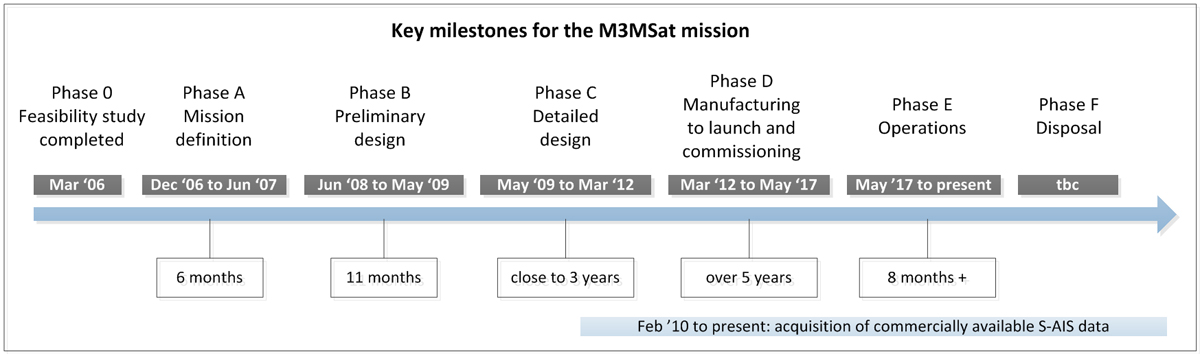
The satellite has three payloads on the 75kg satellite. The primary payload designed for use by the Defence Research and Development Canada (DRDC) is an Automatic Identification System (AIS). The secondary payloads designed for the Canadian Space Agency (CSA) are the Dielectric Deep Charge Monitor (DDCM) and the Low Data Rate System (LDRS). On May 18, 2017 the satellite went into service having completed commissioning.

In a CSA audit of its Satellite Communications Business Line completed in 2018, PRA Inc, the authors of the report, concluded that “Overall, the M3MSat mission allowed the Canadian industry to enhance its expertise and confidence in the potential market for space-based AIS services and to successfully engage in this field. In addition, through commercially available AIS data and services, a number of federal departments and agencies have successfully integrated this type of space-based communications solutions to their operations.”
The report further states that: “In the specific case of the AIS payload, the system has met or exceeded expectations. According to representatives from the CSA, industry, and academia who were interviewed as part of this evaluation, the AIS antenna and system placed on M3MSat have provided one of the most advanced and reliable information on ship movements that is currently available. These results further support the current initiative to integrate AIS and SAR imaging technologies on board the RCM.”
“In the case of the other two payloads (LDRS and DDCM), they have been successfully tested, but they have not been in operation thereafter. Evaluation findings indicate that there was no direct demand for the ongoing operation of these two payloads, and to minimize any potential interference, the decision was made to not operate them beyond the demonstration stage.”
Myriota acquires M3MSat
Myriota provides satellite connectivity for the Internet of Things (IoT). In a press release the compasy said “the acquisition further cements Myriota’s commitment to making a positive contribution to Canada by delivering reliable, low-cost and accessible internet of things connectivity to its industrial industries. The implementation will be supported by Myriota Canada’s on-the-ground team of satellite operations, engineering and spectrum management experts.”
Myriota said that there are “over 200 organizations developing on the Myriota Network for the North American market.” Area of development include “transport and logistics, defense, agriculture, environment, mining, energy and more.”
The sale of the satellite was done by Public Services and Procurement Canada (PSPC) acting for the government. No price was given by Myriota for the purchase of the assets and PSPC also declined to provide a sale price.
As for the “other assets” acquired, Myriota again declined to name them. However, PSPC did respond and said they included a Rack Sat (also referred to in industry as a flat sat), a High Data Rate Receiver Cortex Unit and two Command Ranging & Telemetry Cortex Units.
Along with the AIS payload, Myriota said they plan on using the LDRS but not the DDCM.