Edmonton based Space Engine Systems is preparing to test a small model ramjet on an F-104 Starfighter based at Kennedy Space Center as a next step towards its goal of developing a spaceplane.

This past week Space Engine Systems (SES) provided SpaceQ with an update on its efforts to build a spaceplane. CEO Pradeep Dass told SpaceQ the company is working both in Edmonton and in Florida to move the project ahead.
In particular, the company will be using an F-104 Starfighter from Starfighters Aerospace located at the Kennedy Space Center to test a small model of its ramjet. Dass didn’t provide a date for the test but it will be used “to test material reliability at hypersonic speed.”
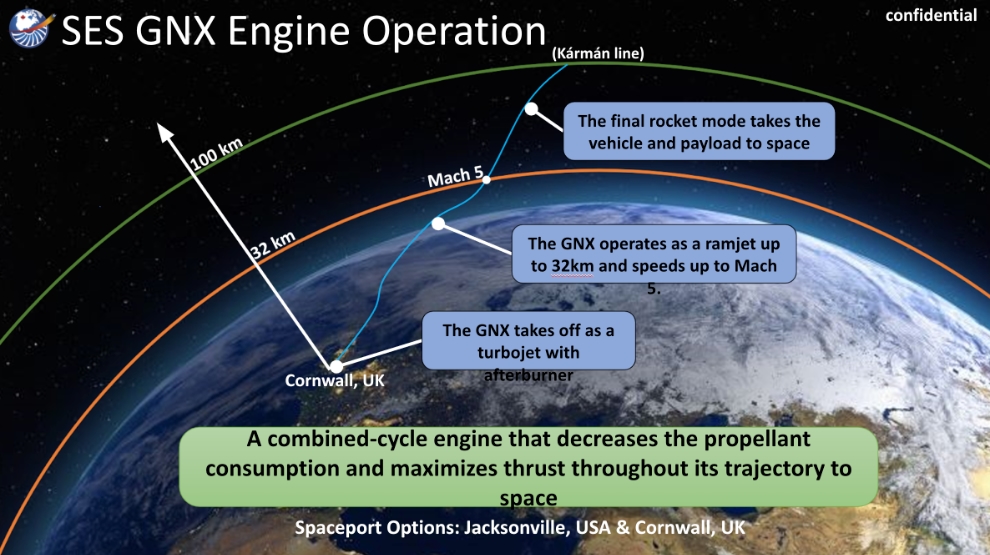
Dass said the small model ramjet “will be released and then it will go all the way to Mach 5 (approximately). We have already tested it on the ground for Mach number simulation. But testing this inflight even in a smaller scale will show us if our cooling methods are working as designed and how the material handling it.” The company is also building a wind tunnel for further testing.
Dass said the company plans on three test phases. The first test phase will be point-to-point tests of the ramjet which they expect to originate from the Cecil Spaceport in Jacksonville. The company is also in negotiations with two other spaceports in the US for testing and possible future use for missions. Dass said they are also in the process of setting up operations in Cornwall, United Kingdom.

While SES is developing the ramjet technology themselves and plan to build their own “vehicle body,” they have outsourced the rocket engine to Aerojet Rocketdyne. “We are collaborating with Aerojet Rocketdyne to adapt their engines to our demonstrator vehicle body.”
The key technology SES is developing is the DASS GNX engine. Dass said the GNX is an “air breathing engine with (a) ramjet with hypersonic capabilities for a minimum of Mach 5. It is probably the 1st hypersonic air breathing turbine engine operating on liquid hydrogen. It has the most efficient and lightest heat exchanger in the world developed at our Alberta facilities in Canada. It is a very simple HX which can remove large MW’s of heat within milliseconds.”
The second phase of testing will be suborbital test flights and the final testing will include sending a payload to low Earth orbit (LEO). The Dass Spaceplane Demonstrator is designed to deliver 550 kg to LEO. A future Dass Spaceplane 4800 is designed to deliver 5,500 kg to LEO. SES still hopes to complete the final test by the end of 2023.
The company is currently hiring and looking for engineers for their Canadian operations. The company states that it’s also in the process of working on a private placement with a valuation of US$120 million after its last successful test.