

C-COM Satellite Systems is touting a significant milestone on the way to making their electronically steerable phased array antennas a reality.
On August 10, 2021, C-COM announced that their electronically steerable phased array antenna is “delivering good results at different scanned angles over the Telesat Anik F3 satellite.”
Bilal Awada, C-COM CTO, said in a release that “Our 1024-element electronically steerable Ka-band, prototype Phased Array Mobile Antenna, performed as expected during scanned angle testing”, and that “we were able to perform speed tests over satellite for scanned angles down to 50 degrees from vertical (antenna boresight).”
Since 1997, C-COM has been providing portable satellite antennas to commercial and consumer-level customers in Canada and across the world. Originally mounted on trucks, C-COM has worked to reduce the size of their portable satellite downlinks to the point that their iNetVU satellite antennas can be carried around by one person in a reasonably portable case. This has been tremendously helpful for companies and organizations working in remote areas in the past, especially those working in areas with little-to-no cell reception with communication needs that can’t be supported by a satellite phone.
Despite the size reduction, though, they’re still parabolic dishes that use mechanical drives to track satellites. That can be extremely limiting, especially considering the growing importance of small, fast-moving, hard-to-target LEO satellite constellations.
C-COM’s ongoing research into phased array mobile antennas can solve this problem. A phased array antenna uses an array of small radio emitters and receivers to create a wave pattern that can detect signals without having to physically move a parabolic dish. Modern phased array antennas, like the one that C-COM is developing, use a large number of small transmitter/receiver elements to track multiple satellites at high speeds simultaneously.
Phased array antennas are already used in some satellite-related applications. SpaceX, for example, uses a mixed mechanical/phased array Ku-band antenna for their Starlink uplinks, and Fleet Space uses digital beamforming in their satellite connections to IoT devices. Other companies are developing phased array antennas as well, aimed principally at the aerospace market.
Where C-COM differs according to CEO Dr. Leslie Klein is that it will be will be “an affordable, electronically steerable Ka-band antenna system capable of operating over the latest constellations of LEO, MEO and GEO satellites, which will play a significant role in delivering broadband solutions to worldwide markets.”
In an email to SpaceQ, Dr. Klein elaborated on their approach. He said that “we are developing a Ka-band version that is modular, conformal and will be plug and play with any Ka-band LEO/GEO and MEO modem/constellation.”
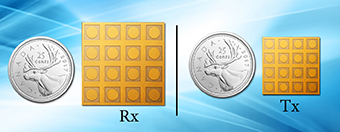
He said that, by using tiled arrays of 4×4 elements — each one being the size of a quarter — it will “make it possible to build … small antennas (for IoT for example) or larger antennas depending on bandwidth requirements.” He added that “the goal is to make this antenna work in full motion, [to be] able to seamlessly track LEO, GEO or MEO constellations while in full motion, and to deploy these in ground, marine and aero environments through our existing and new reseller partners around the world.”
As Klein said, C-COM’s tiled antennas are designed to be scalable. It’s also designed to be flexible, allowing these passive arrays to be attached to curved or irregular surfaces, and to work while in motion. You could put arrays on a car, on a truck, on a plane or helicopter, or even an attachment to a small IoT device. And since it uses a passive phase shifter instead of an active one, C-COM anticipates that it will use less power and be more damage and fault-resistant than other antennas.
So instead of marketing the devices to a small number of commercial operators like some other phased array antenna researchers, or using a single type of antenna for a single constellation like Starlink does, C-COM’s antennas would be aimed at a wide variety of customers for a wide variety of applications. In a previous interview with SpaceQ Klein said that they’re aiming for a price point under $1000, as their manufacturing process matures and they can take advantage of economies of scale.
Their release said that “the Company will continue to move forward and will conduct additional tests to verify the performance of the antenna over several different satellites, including GEO/LEO constellations, and to confirm mobility and interoperability of the new design.”
Assuming all goes well, Klein indicated in his email that “we should have Beta units to test next year and expect to have production units in 2023 or sooner.”