

On Sunday, July 18, 2021, two days before the first crewed flight of the New Shepard suborbital launch vehicle, Blue Origin provided the media with an update that answered some questions but left others unanswered.
Blue Origin’s press conference included updates from key people at the company including; Bob Smith, Blue origin CEO; Steve Lanius, Lead Flight Director; Audrey Powers, Vice President, New Shepard Operations; Chris Jaeger, Chief Engineer, New Shepard; and Ariane Cornell, Director of Astronaut Sales.

For the four “astronauts” on this flight which include Blue Origin’s CEO Jeff Bezos, his brother Mark Bezos, Wally Funk and Oliver Daemen, the most important part of the news conference were the words of reassurance from Lead Flight Director Steve Lanius.
“My number one responsibility as flight director, is the safe execution of this mission and the safety of my launch crew, which includes our astronauts. New Shepard will not launch until I’m satisfied that it is safe to do so. And I give my go for launch.” And with those words, Lanius then gave his go for launch and said “we’ve just successfully passed our flight Readiness Review.”
Lanius has been with “Blue” since 2004 and has been the Lead Flight Director for nine missions. New Shepard has flown 15 times since its first flight on April 29, 2015. All flights have had a successful launch and flight, but the booster on the first flight crashed on landing.
This is the official first commercial flight with paying customers for Blue Origin. However, the anonymous customer that won the auction with a $28 million bid isn’t flying due to a scheduling conflict and will fly at later time. So another customer, Joes Daemen, was selected and he opted to give his son the opportunity to fly. His son, Oliver Daemen is 18, a student attending the University of Utrecht this fall where he will study physics and innovation management. He also has his private pilot’s license.
Daemen will be the youngest person to fly to space. He will be joined by Wally Funk, who at 82 will be the oldest person to fly. According to Wikipedia Funk was the “first female air safety investigator for the National Transportation Safety Board, the first female civilian flight instructor at Fort Sill, Oklahoma, and the first female Federal Aviation Agency inspector, as well as one of the Mercury 13.” While Funk went through similar training as NASA’s Mercury 7, she and the other 12 woman of the privately funded Mercury 13 never flew to space.

New Shepard astronaut training
The press conference shed some light on “astronaut” training. While New Shepard astronauts have to pass a physical, training is limited to two full days. One reason why training is minimal is for the simple reason the New Shepard vehicle is fully autonomous and the flight is suborbital and short. There are no pilots, and there is nothing for the passengers to do other than enjoy the flight.
Lanius described their astronaut training as comprehensive and said, “Our training is comprehensive and gets the crew prepped for everything they need to know about the vehicle. Our astronaut training program is fully compliant with FAA requirements for crew and spaceflight participants. It consists of 14 hours over a two day span and includes classroom instruction, demonstrations and practice in a training capsule. The training covers nominal off nominal and emergency procedures, including Zero GC egress and ingress, emergency egress and fire response and emergency breathing mask usage. The training culminates in mission rehearsals covering five different scenarios in a final exam.”
Lanius went on to comment on the sequence of events leading up to launch. “On launch day rollout (is) at midnight, at approximately t-minus eight hours. Our propellant load begins at t-minus three hours. We’ll give a goal for astronaut load at t-minus 45 minutes, and close the hatch and the crew capsule at t-minus 24 minutes.”

Other tidbits, oh and pricing
From the time of launch to capsule touchdown, the flight will be 10-12 minutes. That’s a lot shorter than the Virgin Galactic experience. However, the New Shepard could fly 20 km higher than Virgin did, reaching perhaps 106 km. Of course the other significant difference is that this is a vertical launch, giving the participants a somewhat similar experience of NASA and other astronauts who launch vertically.
There will be no research payloads on this flight, though there have been 9 missions where research was flown. This “stack” as they call it, consisting of the propulsion module and capsule, has already flown twice with nominal flights.
One of the first questions from reporters was about the addressable market and price. Bob Smith skirted the question to some extent but did offer some insights on the customer base. He did say there were around 7500 who participated in the auction from 150 countries. “Clearly there’s really high interest. So the question really gets down to what’s the price point that we talk about, how far down that will we actually be able to get to, to the number of people that are willing to pay. Willingness to pay continues to be quite high. Our early flights are going for a very good price, you can saw the interest during the auction was quite high. We had people well into the $20’s (million). All very interested.”
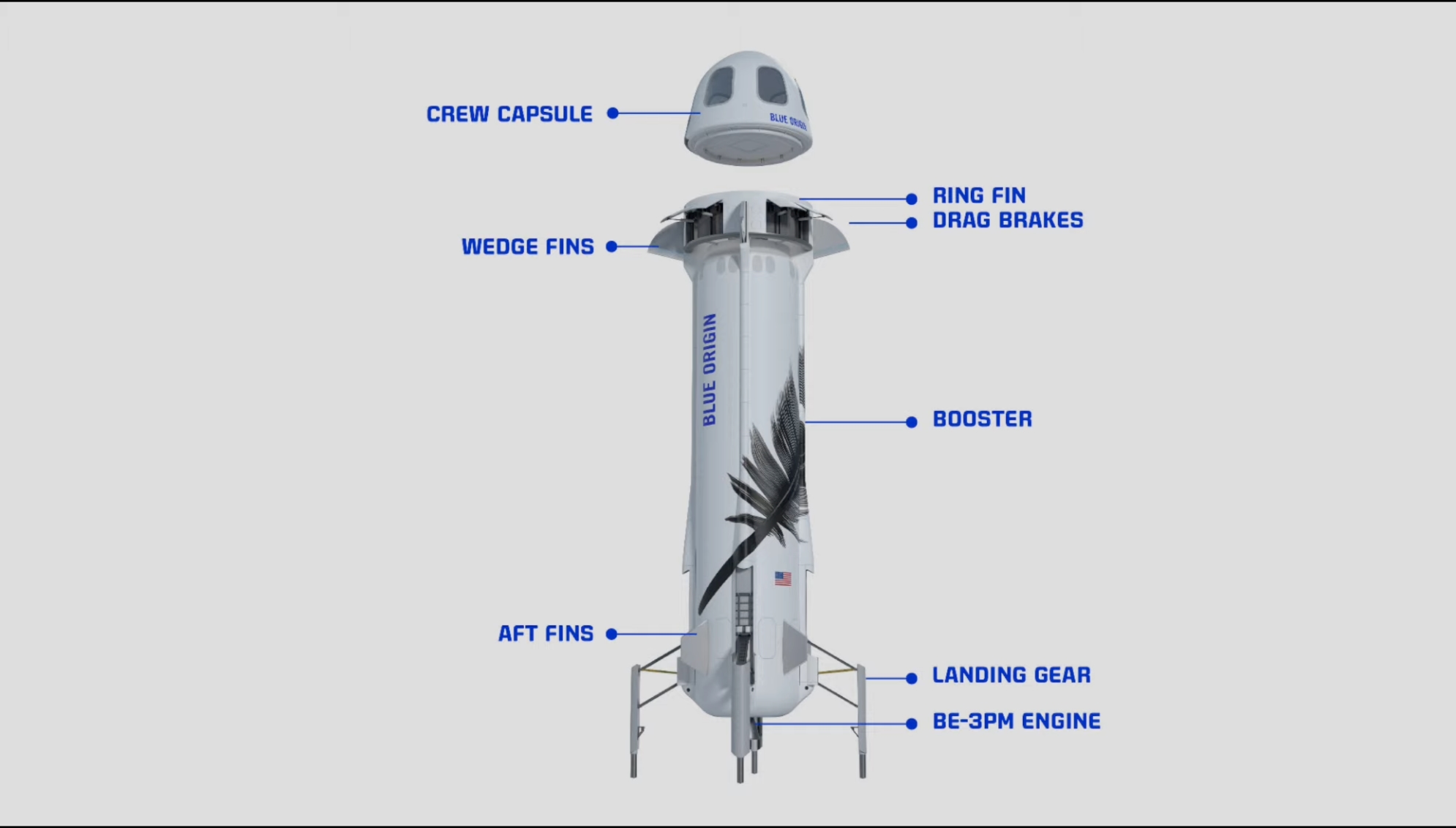
Later in the Q&A, Ariane Cornell, Director of Astronaut Sales answered a related question and said that as previously mentioned, they were going to start selling tickets. The tickets being sold now are being sold to “those that were the most competitive and active bidders.” And Joes Daemen had already been lined up “pretty quickly after the auction itself for the second flight.”
So for now, there appears to be no firm fixed pricing. It seems Blue origin is cherry picking from the 7500 people who participated in the auction for sales. Those who didn’t participate in the auction and want to fly can contact Blue Origin sales to discuss a flight and the cost of a ticket. Blue Origin also stated that they have two more flights planned this year.
The pricing, and lack of a publicly disclosed price, shows a different approach than Virgin Galactic to the market. Of course, the other other significant difference between the two companies, is the ambitions of their CEO. Bezos is building a big rocket, and other hardware for orbital and planetary exploration. New Shepard is in part a test program for their other endeavours. Making money from “tourists” wanting a space experience, is not their prime motivator.