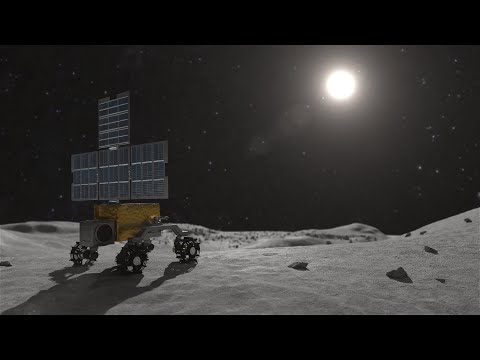
After a year and a half of quiet research and development, Toronto-based STELLS has just emerged from stealth. They’re promising to resolve a potentially major problem with operations on the Moon in the years ahead: powering equipment (especially rovers) in the shadow of lunar craters.
Their solution is to send a rover of their own, the Mobile Power Rover (MPR), which will provide power to other companies’ and organizations’ rovers. The concept appears relatively straightforward: their rover will deposit a charging station in the dark of the crater, and then spool out a cord as it travels out of the crater to a sunlit position. The rover will deploy its solar panels, and will provide power to any other rovers in the area through the charging device. The charging device will feature wireless charging, much like the ones used in modern smartphones, so other rovers need only get close to the STELLS charger in order to get electricity.
According to an interview between STELLS founder Alex Kapralov and SpaceQ, simplicity and reliability is their key goal.
“We have only one payload, [an] important payload like power, so we tried to focus on that,” said Kapralov. “The payload and the sustainability of the rover is what’s most important,” he added, also saying that “we are trying to achieve the maximum survivable rate of the rover [by making it] simple and efficient.”
He emphasized that the rover will have as much redundancy as possible, and that they’re focused on externally sourcing proven “space grade” materials and components as much as possible. They’re also well into extensive testing. Kapralov said that “we’ll take the approach of testing first, and then find out what can be done better.” “We’ve broken a lot of parts [and] burned a lot of PCBs,” he said, even testing a wide variety of different types of cords to connect the rover and charging station.
Kapralov said this also includes simulant and vacuum testing, with vacuum testing carrying the welcome news that wireless charging was indeed going to be more effective in the near-vacuum of the Moon’s atmosphere. They’ve also incorporated a special beacon that lets other rovers know where the STELLS charger is, as the shadowed craters (and omnipresent dust) may make it difficult to see against the regolith.
“We were skeptics ourselves” before they began testing, he admitted. “Will we be able to charge? Will we be able to recover?”

His team hadn’t even started out with power charging in mind. When the serial entrepreneur Kapralov was looking for a new challenge, and was pointed in the direction of space research, his original goal when assembling his team was to lead a scientific mission to do some lunar drilling and perform some spectrometer analysis. They were focused on discovering water on the Moon.
They quickly realized, however, that the shaded areas that were most likely to contain water were also the ones where getting power would be the most challenging. Seeing an opportunity, Kapralov refocused his team on helping other organizations to resolve the power problem. Despite experts’ assurances that it was viable, it took extensive testing to convince them that it’d work, and that “we were able to connect, even without visual,” thanks to the beacon.
As they confirmed that their approach is viable, they began preparing to build what Kaprolov called a “proto-flight”—a space-ready prototype—and to send it to the Moon for in-situ testing. Their targeted date for launch for the “proto-flight” model is November 2024. STELLS’ MPR-1 mission will be launching via a SpaceX Falcon 9, using an Intuitive Machines lunar lander.
According to the company, the goal will be “critical emergency charging,” simulating a situation where “you have a rover that is running low on charge and is going to be unable to reach the sun-exposed area in time.” The release said that “our rover shall locate and rendezvous with this rover and provide power to recharge the batteries…a simple fix to prevent total loss of exploration missions.”
Kapralov pointed to these emergency situations as a key use case for their technology. Even where companies weren’t originally planning on using STELLS’ charging services, as long as they have wireless charging capacity, companies with rovers in challenging situations would be able to call on STELLS to resolve matters.
With the technology progressing and the launch arrangements set, the biggest challenges STELLS faces are familiar ones: attracting talent and financial support. Both of them were named by Kapralov as key reasons why STELLS is exiting from stealth, saying “we’d like to attract more talent; we’d like to attract more public exposure from other participants in the industry… [and] we’d like more partnerships.” While he’s proud of the team members he already has, he knows that he needs more in order to succeed.
As to funding, STELLS is entirely self-funded by Kapralov himself. Kapralov already has successes under his belt, with Doncaster Group, AMKA Holdings and PixFuture, so he’s been able to shepherd the company through its stealth phase.
Now that it’s public, though, he’s open about the search for resources. He said “obviously we will need help from investors [or] from government, and we’re open to collaboration,” but was unable to give any details about any existing or upcoming arrangements. He was able to say that they’re also exploring alternative revenue streams to go along with the power-charging, and that they’re “in talks with different sources of potential funding.”
He was also unable to give details as to whether they were directly pursuing funding from the CSA, NSERC-IRAP, or other Canadian government sources.
Finally, when asked about Astrobotic’s LunaGrid, which aims to provide a similar service, Kapralov said “we’re not sure where exactly they are or what they’re doing,” and that they’d “never heard about the project that was announced in September.” He cautioned, however, that that didn’t mean he was taking a stance on the existence or viability of their technology.